
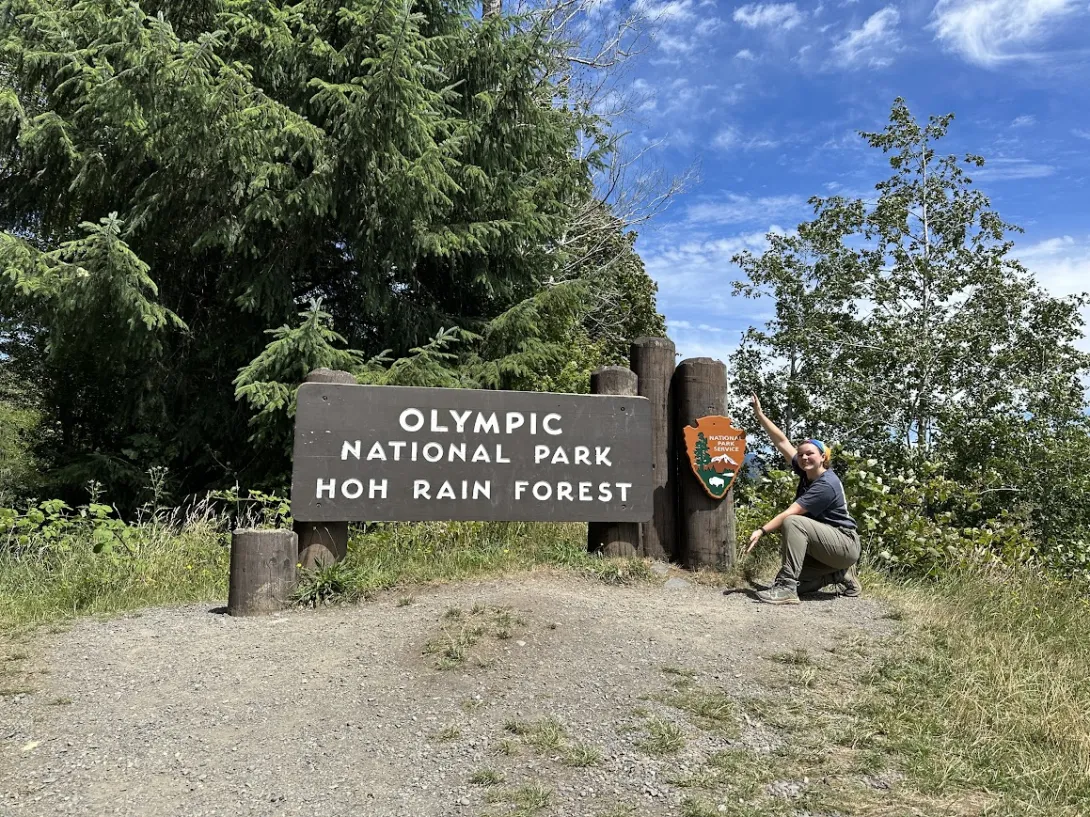
While some people may think summers are meant to be spent on the beach, Kyla Richards spent hers quite a few feet above sea level. She spent it climbing trees in Washington’s Hoh Rainforest in Olympic National Park to research epiphytic bryophytes, a type of non-vascular plant, like mosses and liverworts, that grows on trees.
As part of a six-year longitudinal study led by Michelle Spicer, assistant professor of Earth and environmental sciences, Richards examined secondary succession in moss communities across 12 Acer macrophyllum, or big leaf maple or Oregon maple. Each tree has six plots—three on the trunk and tree on the branches—at varying heights, with every plot containing three subplots subjected to randomized treatments.
“Using within-tree surveys, we identified all epiphytic plants and estimated percent cover of each species in our plots to quantify the diversity, abundance, and community composition at each microsite,” Richards explains. “We were focusing on secondary succession, which hasn't really been studied on these bryophytic microsite communities yet.”
“It’s important because bryophytes are key parts of nutrient cycling and the carbon cycle system and can tell us a lot about atmospheric water.”
Bryophytes don’t have water transport systems, like true roots, so they rely on the atmosphere to get moisture. In this way, the moss remains relatively small and depends on the temperate rainforest environment of Olympic National Park.
Spotlight Recipient
Kyla Richards
Undergraduate Student